
Friday, December 26, 2014
Monday, November 21, 2011
Antique oriental rugs and interior design trends
Antique oriental rugs and interior design trends
Decorating Your Home with Antique Oriental Rugs
When you think about upscale interior design, antiques and fine art are naturally the first items that come to mind. Antiques have an undeniable ability to add personality and character to the décor of any home. Because of their uniqueness many people opt to incorporate antiques into their living spaces. Whether it is something handed down through generations or found in an antique shop many homeowners make “antiquing” a hobby in order to add personal flair to their homes.
 An antique is an item that is at least 80 – 100 years old and for the most part they are both decorative as well as collectible. An antique item is desired and collected because of its age, beauty, rarity, and use. One type of antique that many people collect for their homes are antique rugs. Funnily enough, many of the antique carpets are comparable and at times even cheaper in price than brand new rugs. Once you establish your budget, size requirements and overall look and feel your quest for the right piece begins!
Antique rugs may be found in many different looks and colors. The more “traditional” style carpets such as Tabriz, Kashan and Khorasan will usually have intricate patterns and can be found in a wide array of colors from the jewel tones to the light and airy. These types of pieces give a regal and elegant look to most rooms. However, modern design tends to be simpler in taste and style. Many of the designs in recent years favor a more minimalistic approach to the interior design. Incorporating antique carpets with subtle colors and a more abstract look (like arts and crafts or art deco) will go a long way and will add a warmth and texture to the space.
 Another type of antique carpet that is often used in more modern settings are Moroccan rugs. Moroccan rugs are a fabulous way to invite warmth and create a bright and appealing atmosphere in your home. The simple tribal geometric patterns of these rugs (some of which are taken from the Tattoo designs of the Berber tribes) have been used for some-time to allow a sophisticated look to go with modern furniture. Many historic homes boast these vintage Moroccan rugs such as one of America’s most famous architects of the modern era: Frank Lloyd Wright.Although, it is more traditional to display your antique carpet on the floor, it can also be displayed on the wall as a work of art (which the antique carpets and vintage rugs actually are). In the right lighting you will be able to see the artistry behind these artisanal antique rugs.
A rug tends to be the most expensive item in a room when decorating so it is imperative to get a piece that you will love for a long time. It is also important to purchase the rug from a dealer that you trust. A good dealer will provide you with information, images, and history of the rug as well as give you the option to trade in the rug for a different piece in the future. Be wary of dealers who tell you that the rug will be worth much more in “X” years because there is no way to estimate what any piece will fetch in the future as demands will always change to fit the ever-changing interior design trends. It is best to establish a good relationship with your dealer since down the line you might want to acquire a better piece or might simply want a different look.
So, why buy an antique rug? They clearly allow a very versatile and stylish look for your home decor. With their patina (that can only come with age), texture and their variety of colors and designs, they can liven up any modern, traditional or casual room and make your interior look picturesque and magnificent.
Over the years the trends, patters, and design of interiors have been reinventing themselves every few years but the demand and appreciation for antique oriental rugs has remained. Great antique carpets, just like great paintings will never go out of style and the demand has only increased over the years.
When you think about upscale interior design, antiques and fine art are naturally the first items that come to mind. Antiques have an undeniable ability to add personality and character to the décor of any home. Because of their uniqueness many people opt to incorporate antiques into their living spaces. Whether it is something handed down through generations or found in an antique shop many homeowners make “antiquing” a hobby in order to add personal flair to their homes.
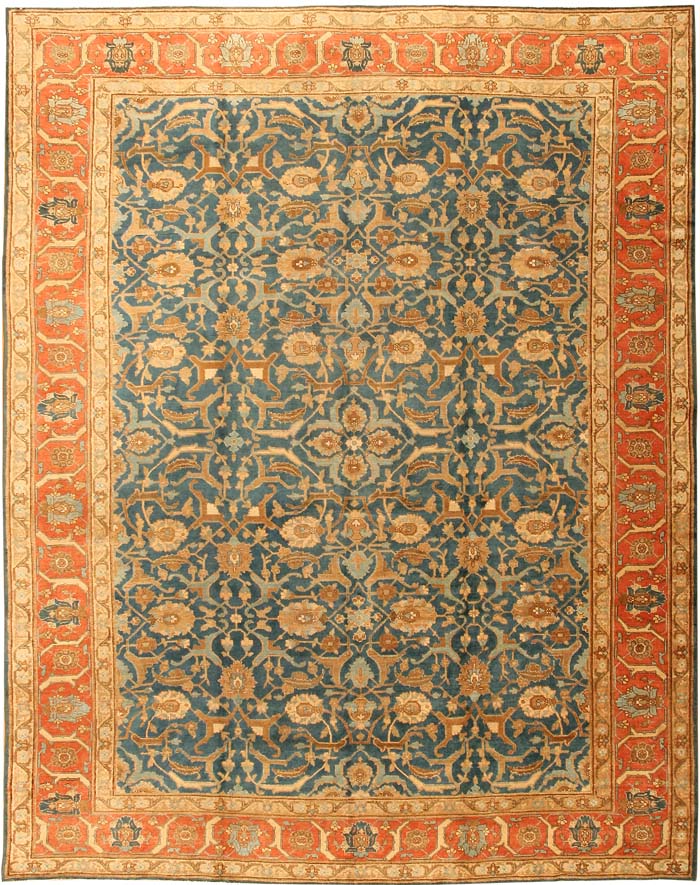
Tabriz Rugs
Antique rugs may be found in many different looks and colors. The more “traditional” style carpets such as Tabriz, Kashan and Khorasan will usually have intricate patterns and can be found in a wide array of colors from the jewel tones to the light and airy. These types of pieces give a regal and elegant look to most rooms. However, modern design tends to be simpler in taste and style. Many of the designs in recent years favor a more minimalistic approach to the interior design. Incorporating antique carpets with subtle colors and a more abstract look (like arts and crafts or art deco) will go a long way and will add a warmth and texture to the space.
 Another type of antique carpet that is often used in more modern settings are Moroccan rugs. Moroccan rugs are a fabulous way to invite warmth and create a bright and appealing atmosphere in your home. The simple tribal geometric patterns of these rugs (some of which are taken from the Tattoo designs of the Berber tribes) have been used for some-time to allow a sophisticated look to go with modern furniture. Many historic homes boast these vintage Moroccan rugs such as one of America’s most famous architects of the modern era: Frank Lloyd Wright.
A rug tends to be the most expensive item in a room when decorating so it is imperative to get a piece that you will love for a long time. It is also important to purchase the rug from a dealer that you trust. A good dealer will provide you with information, images, and history of the rug as well as give you the option to trade in the rug for a different piece in the future. Be wary of dealers who tell you that the rug will be worth much more in “X” years because there is no way to estimate what any piece will fetch in the future as demands will always change to fit the ever-changing interior design trends. It is best to establish a good relationship with your dealer since down the line you might want to acquire a better piece or might simply want a different look.
So, why buy an antique rug? They clearly allow a very versatile and stylish look for your home decor. With their patina (that can only come with age), texture and their variety of colors and designs, they can liven up any modern, traditional or casual room and make your interior look picturesque and magnificent.
Over the years the trends, patters, and design of interiors have been reinventing themselves every few years but the demand and appreciation for antique oriental rugs has remained. Great antique carpets, just like great paintings will never go out of style and the demand has only increased over the years.

Friday, June 19, 2009
Kashan A Green Oasis
Kashan A Green Oasis
Kashan, Iran Tehran, June 19, 2009: Kashan is the first of the large oases along Qom-Kerman Road that passes near the edge of a desert. Its attractiveness is mainly due to the contrast between the greenery of the oasis and the parched desert. The city flourished during the Sassanid dynasty, but was demolished during the Arab invasion with the exception of a few ancient buildings. It prospered again during the Seljuk rule and is known for its ceramics since then. Though it was destroyed again during the invasion of Mongols, it became an important town in the Safavid rule and Shah Abbas II made the city its capital. Some Safavid rulers, however, preferred to live in Kashan rather than in the capital. A local historian wrote that Kashan’s name is derived from “Key Ashian“ which means place of rulers, Iranchamber.com reported. Location Bound by Isfahan, Qom and Markazi provinces, Kashan is located near Ardestan and Natanz. Kashan has been overshadowed by Isfahan, but is considered one of the ancient cities of Iran. Archeological discoveries on the Siyalk Hillocks, which lie 4 km west of Kashan, have revealed that it was one of the primary centers of civilization in prehistoric times.

Kashan, Iran Tehran, June 19, 2009: Kashan is the first of the large oases along Qom-Kerman Road that passes near the edge of a desert. Its attractiveness is mainly due to the contrast between the greenery of the oasis and the parched desert. The city flourished during the Sassanid dynasty, but was demolished during the Arab invasion with the exception of a few ancient buildings. It prospered again during the Seljuk rule and is known for its ceramics since then. Though it was destroyed again during the invasion of Mongols, it became an important town in the Safavid rule and Shah Abbas II made the city its capital. Some Safavid rulers, however, preferred to live in Kashan rather than in the capital. A local historian wrote that Kashan’s name is derived from “Key Ashian“ which means place of rulers, Iranchamber.com reported. Location Bound by Isfahan, Qom and Markazi provinces, Kashan is located near Ardestan and Natanz. Kashan has been overshadowed by Isfahan, but is considered one of the ancient cities of Iran. Archeological discoveries on the Siyalk Hillocks, which lie 4 km west of Kashan, have revealed that it was one of the primary centers of civilization in prehistoric times.

Kashan has long been known as a flourishing center of arts and a cradle of Iranian artists. The cultivated, talented and dynamic people of this historical city have been famous as manufacturers of excellent glazed vessels and tiles, weavers of fine brocades, velvets and silk fabrics and creators of superb carpets and rugs. As producers of various handicrafts, Kashan has consistently ranked as outstanding exponents of numerous other arts and crafts. It also boasts of various historical buildings and sites, which attract both domestic and foreign tourists. Agha Bozorg Mosque This mosque as well as the theological school, Madraseh Agha Bozorg, is located in central Kashan. The mosque consists of two large corridors, one in front of the prayer niche and another by the entrance. It also has a courtyard with a garden and a fountain in the middle. The courtyard is surrounded by arcades. The corridor in front of the prayer niche has two minarets and a brick dome. The colors of arcades and corridor are mainly blue, red and yellow against a brick ground. Boroujerdi Residence This used to be a private home but now is open to public as a museum. The house was built in early 19th century and consisted of a vast courtyard, beautiful wall paintings and very unusual wind towers that help cool the house. Bagh-e Fin Bagh-e Fin is located a few kilometers southwest of Kashan, in the small village of Fin. It is one of the most famous gardens of Iran. This beautiful garden, with a large pool and orchards, was designed for Shah Abbas I as a classical Persian vision of paradise. The original Safavid buildings were rebuilt by Qajar dynasty, although the layout of trees and marble basins is close to the original. It is a pleasant spot to relax in. The garden is also notorious for being the site of the murder of Mirza Taqi Khan known as Amir Kabir, the minister of Nassereddin Shah of Qajar in 1852. Friday Mosque Friday Mosque or Masjed-e Jomeh, with its 11th-century prayer niche, was built during the Seljuk era and has been restored several times. One such renovation dates back to Timurid Dynasty and has a minaret with ancient inscriptions. Tabatabaie Residence The house was built in the 19th century and consists of a charming courtyard and beautiful windows with color glass panes. This used to be a private home but now is open to public as a museum. Tappe-ye Sialk The most significant archeological site in central Iran is the Sialk Mound. It was excavated by Gershman in the 1930s, which revealed that the site is more than 7,000 years old. Sialk was occupied from 4th millennium BC until 8th century BC. Probably, one of the most interesting findings are inscribed clay tablets dating back to the late 3rd and early 2nd millennium BC. There are also records showing immigrants and conquerors passing through this region and settling near Bagh-e Fin. The artifacts uncovered are displayed in the Louvre Museum in Paris and the archeological museum in Tehran. Officials are making efforts to publicize Kashan as an attractive tourism spot and the increasing number of visitors shows that they have been successful.
Thursday, June 4, 2009
Obama admits US involvement in Iran coup in 1953
"Obama admits US involvement in Iran coup in 1953
Jun 4 01:30 PM US/Eastern
US President Barack Obama made a major gesture of conciliation to Iran on Thursday when he admitted US involvement in the 1953 coup which overthrew the government of Prime Minister Mohammad Mossadegh.
"In the middle of the Cold War, the United States played a role in the overthrow of a democratically elected Iranian government," Obama said during his keynote speech to the Muslim world in Cairo.
It is the first time a serving US president has publicly admitted American involvement in the coup.
The CIA, with British backing, masterminded the coup after Mossadegh nationalised the oil industry, run until then in by the British-owned Anglo-Iranian Oil Company.
For many Iranians, the coup demonstrated duplicity by the United States, which presented itself as a defender of freedom but did not hesitate to use underhand methods to get rid of a democratically elected government to suit its own economic and strategic interests."
http://www.breitbart.com/article.php?id=CNG.32cde4b38d55ae6af28266bb31a7221e.851&show_article=1
Monday, May 25, 2009
Mousavi will not resort to every ploy to win the election.
Ex-MP urges Judiciary to stop mudslinging
Former MP Emad Afrough has urged the Judiciary to prevent any kind of mudslinging by presidential candidates or their supporters if any presidential aspirant decides to name his cabinet.
Ayatollah Taheri supports Mousavi candidacy
Ayatollah Hassan Taheri stated on Saturday that he supports presidential hopeful Mir-Hossein Mousavi in the upcoming election. “We will be happy, pleased, and content if you win the tenth presidential election,” he said in a meeting with Mousavi in Isfahan.
Mousavi visited Ayatollah Taheri’s home during his visit to Isfahan Province. Mousavi emphasized that Ayatollah Taheri has played an important role in the Islamic Revolution.
Mousavi not to resort to any ploy to gain power
The Servants of Construction Party spokesman, Hossein Mar’ashi, stated on Saturday that Mousavi will not resort to every ploy to win the election.
“One of the most important reasons for supporting Mousavi is that Mousavi believes in the content of the Islamic Republic of Iran and will not resort to every effort to stay in power,” he told the MNA.
Mar’ashi added, “Preserving the Islamic Republic does not mean preserving its form, rather it means preserving the content of the Islamic republic… The content of the Islamic Republic means people should have freedom and the right to choose.”
Relations with Europe, U.S will be the hottest issue
The Islamic Coalition Party has issued a statement stating that relations with Europe and the U.S. will be the hottest issue for the next administration.
“Undoubtedly, our most important issue in the next administration is defining the new relations with Europe and the United States based upon wisdom and the system’s expedience and with an emphasis on resistance, perseverance, and maintaining the country’s independence,” part of the statement read.
The statement cited some goals that the next administration should realize and insisted that President Mahmoud Ahmadinejad is able to materialize those objectives if he wins the election. The ICP has previously announced its support for Ahmadinejad.
Mousavi ally opposes naming cabinet before election
Expediency Council member Majid Ansari stated on Saturday that naming cabinet before the election is not “expedient”.
“I do not agree with introducing the cabinet by the candidates before the election because (one) cannot introduce an inclusive cabinet in such a short time,” he told the MNA. Ansari supports Mousavi in the election.
Mousavi will try to resolve workers’ problems
Former MP Soheila Jelodarzadeh has said that Mousavi will try to relieve the problems of the working class. “Mousavi’s most important plan in supporting workers is to restore suitable conditions for working and production (sector) in the country,” she told the MNA in Semnan Province on Saturday. Jelodarzadeh, a defender of the labor class, leads the coalition of Mousavi’s supporters.
Mousavi looks for “peace of mind” in the society
Mousavi has stated that he will make efforts to bring about a “peace of mind” in the society.
“One of my slogans is freedom from fear … Fear does not have only a physical meaning, rather, peace of mind should be created in the society. This will not happen unless an administration’s most efforts go into resolving economic problems,” he said on national TV on Friday night.
Friday, May 8, 2009
Mount Damavand Iran
 Snow-covered Mount of Damavand, the highest peak in the Middle East (Photo by Oshin D. Zakarian)
Thursday, April 30, 2009
Tanavoli’s “The Wall and the Script”, brings $218,500 Dubai
Christie’s Dubai Sale Raises $4.8 Million on Trimmed Estimates
By Ayesha Daya
April 30 (Bloomberg) -- Christie’s International sold $4.8 million of art last night in Dubai, within estimates, after the auction house trimmed prices as the economy slowed and its previous sale missed targets.
The most expensive lot was Parviz Tanavoli’s “The Wall and the Script”, a bronze sculpture enveloped in Farsi script that sold for $218,500, compared with a $120,000-$180,000 estimate. A year ago, Tanavoli’s sculpture “The Wall (Oh Persepolis)” sold for 10 times as much, fetching a record $2.84 million in Dubai. Christies had estimated the art sale would tally $4.1 million to $5.9 million.
“Buyers are still active and works represent good value with re-adjusted estimates which still represent multiples of values of 2 to 3 years ago,” said Michael Jeha, managing director of Christie’s Middle East, in an e-mailed response to questions before the sale. “We have pitched our estimates conservatively and are sensitive to the environment in which we and our clients are operating.”
The proportion of lots selling at some international auctions has declined as buyers hesitate in the worst recession since the Great Depression, with Christie’s looking for cash from emerging markets in the Middle East, Asia and Russia to boost sales.
The auction was for art from the Middle East and North Africa. Christie’s said it was the first time works from Saudi Arabia had been offered in an international auction.
Christie’s previous Dubai auction of paintings in October raised $8.6 million, half its estimate of $15 million to $18 million.
To contact the reporter on this story: Ayesha Daya in Dubai adaya1@bloomberg.net
Last Updated: April 30, 2009 02:49 EDT
Subscribe to:
Posts (Atom)